

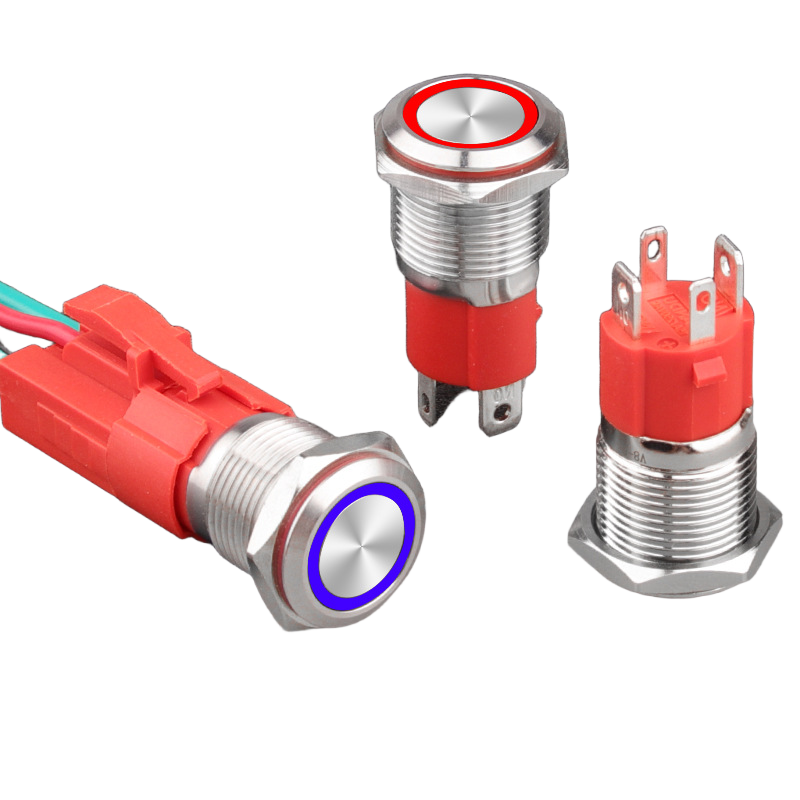
 In the design of industrial control panels, outdoor equipment, and automation systems, the selection of push button switches is often treated as a minor detail. However, when equipment requires frequent start-stop cycles in humid environments or needs stable conduction under low-temperature conditions, a seemingly insignificant difference in current rating can become the defining factor in system reliability.
This article focuses on a 5-120V wide voltage, 7.5A high current 12mm metal push button switch, conducting an in-depth comparison with ordinary 12mm metal push button switches in terms of functionality, current limitations, and application scenarios. Our goal is to help B-end purchasers and engineers make choices that stand the test of time.
1. Why Does Current Rating Matter So Much for 12mm Metal Push Button Switches?
The 12mm metal push button switch belongs to the category of miniaturized human-machine interface components. With a mounting hole size of only 12mm, it must simultaneously meet requirements for mechanical strength, electrical performance, and protection level within a limited space .
Typical Current Limitations of Ordinary 12mm Metal Buttons
Based on market research, the rated current of ordinary 12mm metal push button switches mainly falls within the following ranges:
| Switch Type | Typical Rated Current | Applicable Voltage | Main Application Limitations |
|---|---|---|---|
| Basic Non-Lighted Switch | 0.1A – 2A | ≤36V DC | Suitable only for signal circuits, cannot drive loads |
| Ordinary Lighted Switch | 1A – 3A | ≤125V AC | LED illumination consumes part of current, limited load capacity |
| Industrial Grade Ordinary Switch | 3A – 5A | ≤250V AC | Can drive small motors, but noticeable heating during continuous operation |
| 7.5A High Load Switch | 7.5A | 5-120V AC/DC | Can directly drive medium loads, no intermediate relay required |
Physical Determinants of Current Limitation
Why is there a multiple-fold difference in current-carrying capacity among switches with the same 12mm mounting hole? The core factors are:
Contact Material and Area: Ordinary switches use silver-plated or copper contacts, often with contact resistance above 50mΩ; high-load switches use large silver contacts, achieving contact resistance as low as 15mΩ
Pin Plating: Gold-plated pins ensure conductivity while preventing oxidation, maintaining low contact resistance over long-term use
Internal Structure Design: Dual-spring pre-tension design maintains stable contact pressure, preventing contact chatter under high current
2. 7.5A High Load Switch vs. Ordinary Switch: Core Parameter Comparison
2.1 Electrical Parameters Comparison
| Comparison Dimension | Ordinary 12mm Metal Button | 7.5A High Load 12mm Metal Button | Engineering Significance |
|---|---|---|---|
| Rated Current | 2-3A (most models) | 7.5A | High load switch can directly drive small motors, solenoid valves, heaters, etc. |
| Voltage Range | 12-24V DC or 125V AC | 5-120V AC/DC | Wide voltage design compatible with both low-voltage control and medium-voltage loads |
| Contact Resistance | ≤50mΩ | ≤15mΩ | Low contact resistance reduces heat generation, extends lifespan |
| LED Driving Method | Simple resistor current limiting | Constant current drive circuit | Ordinary switch LED brightness fluctuates with voltage, prone to burnout |
| Electrical Life | 50,000 cycles | 100,000+ cycles | High load switch lasts longer under full load conditions |
2.2 Mechanical & Environmental Parameters Comparison
| Comparison Dimension | Ordinary 12mm Metal Button | 7.5A High Load 12mm Metal Button | Engineering Significance |
|---|---|---|---|
| Mechanical Life | 500,000 cycles | 1,000,000+ cycles | Suitable for frequent operation scenarios |
| Protection Rating | IP65 (most) | IP65/IP67 | Similar waterproof/dustproof capability, but high load switch has more reliable sealing structure |
| Contact Material | Silver alloy (standard grade) | Large silver contacts + gold-plated pins | Silver contacts ensure conductivity, gold plating prevents oxidation |
| Operating Temperature | -20℃~+55℃ | -40℃~+120℃ | High load switch adapts to harsher environments |
2.3 Functional Features Comparison
| Comparison Dimension | Ordinary 12mm Metal Button | 7.5A High Load 12mm Metal Button | Engineering Significance |
|---|---|---|---|
| Operation Mode | Latching or momentary (single) | Latching/momentary optional, illuminated | Flexible adaptation to different control requirements |
| LED Illumination | Single color, brightness fluctuates with voltage | Multiple luminous colors, constant current drive | Clear status indication, longer lifespan |
| Mounting Method | Threaded mounting | Threaded mounting + waterproof ring | More reliable sealing |
| Terminal Type | Solder lug or pin | Gold-plated pins/wire leads optional | Flexible wiring, oxidation resistant |
3. In-Depth Application Scenario Analysis: Advantages & Disadvantages
3.1 Industrial Machinery and Equipment
Ordinary Switch Performance:
Advantages: Low cost, suitable for simple signal control
Disadvantages: 2-3A current limitation requires intermediate relay to drive contactors or small motors; contacts prone to oxidation in oil mist environments
7.5A High Load Switch Performance:
Advantages: Can directly drive small motors (≤900W@120V), solenoid valves, indicator light groups; large silver contacts resist arcing, suitable for frequent start-stop machine tools
Disadvantages: Higher unit cost than ordinary switches
Ideal Scenarios: Machine tool control panels, automation equipment start/stop, conveyor line control
3.2 Outdoor Equipment & Charging Facilities
Ordinary Switch Performance:
Advantages:IP65 basic waterproofing handles light rain
Disadvantages:Long-term UV exposure degrades sealing gaskets; current limitation insufficient for charging station high current demands
7.5A High Load Switch Performance:
Advantages: IP67 protection rating with fluororubber O-ring withstands heavy rain and high-pressure water jets ; 7.5A current capacity suitable for charging station status switching and auxiliary circuits
Disadvantages: Requires precise panel hole machining to maintain protection rating
Ideal Scenarios: Charging station operator panels, outdoor distribution boxes, landscape lighting control
3.3 Automotive & Marine Electronics
Ordinary Switch Performance:
Advantages: Compact size, suitable for space-constrained control consoles
Disadvantages: Contacts prone to oxidation in 12V/24V systems; contact reliability decreases in vibration environments
7.5A High Load Switch Performance:
Advantages: Gold-plated pins resist corrosion in humid, salt-spray environments ; wide voltage 5-120V compatible with different vehicle models; ring illumination easily identifiable at night
Disadvantages: Requires attention to installation torque (5-14N·m) to ensure waterproofing
Ideal Scenarios: Marine control panels, modified vehicle function switches, construction vehicle cabins
3.4 Medical Equipment
Ordinary Switch Performance:
Advantages: Cost-controllable
Disadvantages: Reliability may not meet medical certification requirements; LED brightness drift affects status indication
7.5A High Load Switch Performance:
Advantages: Stable contact resistance, suitable for precise signal transmission; constant current LED drive ensures consistent brightness ; long lifespan reduces equipment maintenance frequency
Disadvantages: May require additional EMC compatibility considerations
Ideal Scenarios: Diagnostic equipment operation keys, rehabilitation therapy machine controls, hospital bed call terminals
4. Engineering Selection Guide: When to Choose the 7.5A High Load Switch?
4.1 Scenarios Recommending 7.5A High Load Switch
Direct Load Driving: When the switch needs to directly control motors, solenoid valves, heaters, etc., with load current within 7.5A, eliminating intermediate relays
Wide Voltage Applications: Equipment needs to operate in regions with different voltages, or requires compatibility with both DC and AC power sources
Harsh Environments: High humidity, salt spray, oil mist, large temperature differential conditions
Long Lifespan Requirements: Equipment designed for 5+ years service life, minimizing maintenance replacement
Status Indication Needs: Multi-color LEDs required for clear equipment status indication
4.2 Scenarios Still Suitable for Ordinary Switches
Pure Signal Control: Only used for PLC inputs, access control signal triggering, etc., low current applications
Indoor Dry Environments: Office equipment, household appliance controls
Cost-Sensitive Projects: Large volume simple applications, allowing addition of external relays
Disposable or Short-Life Equipment: Simple devices with 1-2 year service life
5. Technical Principle Analysis: How is 7.5A Achieved in Compact Size?
5.1 Contact Engineering Breakthrough
Ordinary 12mm switches, limited by volume, typically have contact area less than 0.5mm². The 7.5A high load switch employs:
Large Silver Contacts: Contact area up to 0.8mm²+, reducing current density
Double-Layer Tungsten-Copper Spring: Provides 1.2N pre-tension force, ensuring stable contact
Silver Alloy Material: Combines high conductivity with arc resistance
5.2 Thermal Management Design
Metal housing acts as heat sink, rapidly conducting internal heat to the mounting panel
Low contact resistance (≤15mΩ) reduces I²R heat generation to less than 1/3 of ordinary switches
5.3 LED Drive Circuit Optimization
Ordinary switch LEDs use simple resistor current limiting; when voltage increases from 12V to 24V, current surges 300%, causing rapid LED degradation . The 7.5A high load switch employs:
Constant current diode + current limiting resistor combination, maintaining stable operating current of 8-12mA
3-24V wide input voltage ensures LED brightness fluctuation under ±8%
6. Procurement & Selection Recommendations
6.1 Key Parameter Confirmation Checklist
When requesting quotes from suppliers, confirm the following parameters:
Rated Current: Does it meet 7.5A continuous operation? Is derating required?
Contact Material: Is it silver alloy + gold-plated pins?
Protection Rating: IP65 or IP67? Seal material (fluororubber优于 silicone)
LED Drive Method: Constant current or resistor limiting?
Mechanical Life Test Report: Has it undergone 100,000+ cycle actual testing?
6.2 Installation Precautions
Hole Precision: 12mm mounting hole tolerance should be controlled within ±0.1mm
Installation Torque: 5-14N·m, over-tightening may damage sealing ring
Soldering Specifications: 320℃±20℃, time under 3 seconds, avoid damaging internal components
Conclusion
Though small in size, the 12mm metal push button switch serves as the first interface of human-machine interaction. Through engineering innovations including large silver contacts, gold-plated pins, and constant current LED drive, the 7.5A high load switch achieves load capacity and reliability far exceeding ordinary switches within a compact package.
For B-end users pursuing long-term system stability, choosing high load switches is not merely a technical decision but a strategic choice to reduce Total Cost of Ownership (TCO)—the eliminated intermediate relays, reduced故障停机 time, and extended maintenance cycles deliver value far exceeding the switch’s price difference.
The essence of engineering selection is not choosing the cheapest, but choosing the one least likely to require rework.
PornPics
May you always find beauty and joy in the simple things of life