 In the world of industrial control systems, precision switching is non-negotiable. For engineers, panel builders, and procurement specialists seeking a versatile, multi-circuit control solution, the 4PDT 12-pin toggle switch stands out as a robust and reliable component. But what exactly does “4PDT” mean, and why would you choose this configuration over simpler switch types?
This guide provides a comprehensive technical overview of the 4PDT toggle switch, covering its internal architecture, common applications, wiring best practices, and key selection criteria for B2B buyers.
1. Understanding the 4PDT Configuration
To fully appreciate the capabilities of a 4PDT toggle switch, it helps to decode its name:
4PDT: Four Pole, Double Throw
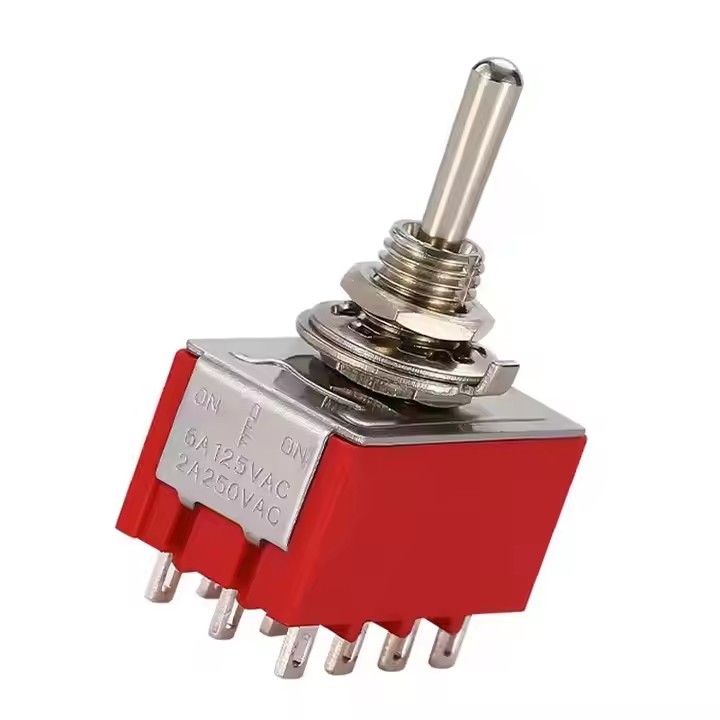
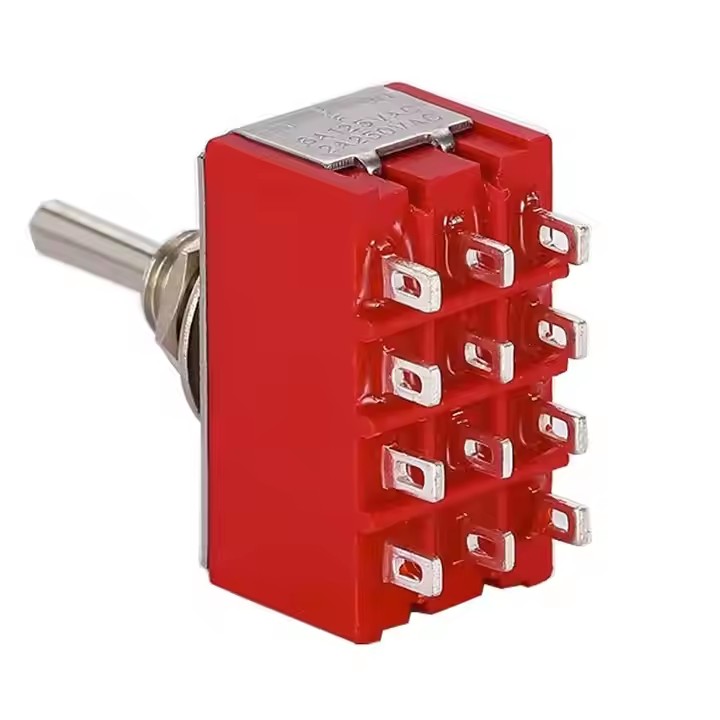
12-Pin: The switch features 12 terminals (4 poles × 3 terminals per pole)
| Term | Meaning |
|---|---|
| Pole | The number of separate circuits the switch can control simultaneously |
| Throw | The number of positions to which each pole can connect |
In a 4PDT configuration:
Each of the 4 poles is a distinct, isolated circuit
Each pole has 3 terminals: Common (C), Normally Open (NO), and Normally Closed (NC)
The toggle lever allows each Common terminal to be connected to either the NO or NC terminal, depending on the switch position
This gives you the ability to control up to 4 independent circuits with a single switch, with two possible states per circuit.
2. 4PDT vs. Other Switch Configurations
For B2B buyers evaluating switch options, understanding the trade-offs between configurations is essential:
| Switch Type | Poles | Throws | Circuits Controlled | Typical Use Case |
|---|---|---|---|---|
| SPST | 1 | 1 | 1 (on/off) | Simple power switching |
| DPDT | 2 | 2 | 2 circuits, 2 states each | Motor reversing, stereo audio switching |
| 3PDT | 3 | 2 | 3 circuits, 2 states each | True bypass in audio effects, three-phase control |
| 4PDT | 4 | 2 | 4 circuits, 2 states each | Complex industrial controls, multi-function switching |
The 4PDT toggle switch occupies a unique niche: it offers the highest circuit density in a standard toggle form factor, allowing designers to consolidate multiple switching functions into a single panel-mounted component.
3. Common Applications in B2B Environments
Thanks to its multi-pole capability, the 4PDT 12-pin toggle switch is widely used across several industrial and commercial sectors:
Industrial Control Panels
Engineers frequently use 4PDT switches to control multiple signal lines or low-power loads simultaneously. For example, a single toggle can activate four separate indicator lights, initiate multiple relays, or switch between two sets of four sensors.
Audio and Broadcast Equipment
In professional audio, 4PDT toggles are prized for balanced signal switching. Since balanced audio requires two conductors per channel, a 4PDT switch can handle two stereo balanced signals or four unbalanced signals with a single lever.
Test and Measurement Instruments
Laboratory and production test equipment often requires switching between multiple signal sources or measurement points. A 4PDT toggle allows operators to reconfigure signal paths quickly without complex menu navigation.
Medical Devices
In diagnostic and monitoring equipment, reliability is paramount. 4PDT toggles provide positive tactile feedback and mechanical durability, making them suitable for critical mode selection functions.
Aerospace and Defense
Where ruggedness and failsafe operation are mandatory, military-grade 4PDT toggle switches are used for system reconfiguration, redundant circuit selection, and failover switching.
4. Wiring the 4PDT 12-Pin Toggle Switch
Proper wiring is critical to leveraging the full capabilities of a 4PDT switch. The 12 pins are typically arranged in two rows of six, or in a circular pattern depending on the manufacturer.
Pin Configuration (Typical)
| Pole | Common | NO (Position 1) | NC (Position 2) |
|---|---|---|---|
| Pole 1 | Pin 1 | Pin 2 | Pin 3 |
| Pole 2 | Pin 4 | Pin 5 | Pin 6 |
| Pole 3 | Pin 7 | Pin 8 | Pin 9 |
| Pole 4 | Pin 10 | Pin 11 | Pin 12 |
Note: Pin numbering varies by manufacturer. Always refer to the product datasheet before wiring.
Basic Wiring Example: Dual Voltage Selection
If you need to select between two sets of four control signals:
Connect four input signals to the Common terminals (one per pole)
Connect Output Set A to the NO terminals
Connect Output Set B to the NC terminals
When the toggle is in Position 1, all four Common terminals connect to Set A
When toggled to Position 2, all four Common terminals connect to Set B
This configuration allows instant switching between two complete sets of circuits with a single action.
5. Key Selection Criteria for Procurement
When sourcing 4PDT 12-pin toggle switches for your projects, consider these critical specifications:
Electrical Ratings
Current Rating: Typically ranges from 0.5A to 15A at 125V AC, depending on the contact material
Voltage Rating: Confirm both AC and DC voltage capabilities if your application involves mixed power types
Mechanical Specifications
Actuator Style: Bat handle, flat lever, or locking toggle (prevents accidental switching)
Bushing Thread: Standard sizes include 1/4″-40, M6, or M12; ensures compatibility with your panel or enclosure
Mechanical Life: Quality switches are rated for 30,000 to 100,000 cycles or more
Environmental Protection
Sealing: Look for IP67 or IP68 ratings if the switch will be exposed to moisture or dust
Temperature Range: Industrial applications often require -20°C to +85°C or broader
Mounting Style
Panel Mount: Most common; secures with a threaded bushing and hex nut
PC Pin / Through-Hole: For PCB integration
Solder Lug: For wire-to-switch connections in custom assemblies
Certifications
UL / CSA: Essential for North American markets
CE / RoHS: Required for European markets
IP Rating: Important for harsh environment applications
6. Installation Best Practices
To ensure long-term reliability of your 4PDT toggle switches:
Use a Proper Panel Hole — Drill a clean hole matching the bushing diameter; deburr edges to prevent damage to the switch housing
Tighten Securely — Use the included hex nut and lock washer to prevent rotation during operation
Match Wire Gauge — Ensure wiring matches the current rating; undersized wires can overheat
Protect Against Voltage Spikes — If switching inductive loads (motors, solenoids, relays), consider adding snubber circuits or using the switch to control external relays
Test Before Final Assembly — Verify continuity across all four poles in both positions before sealing the panel
7. Quality Indicators for B2B Buyers
For industrial and commercial applications, reliability is non-negotiable. When evaluating suppliers, look for:
Detailed Datasheets: Clear specifications for electrical ratings, mechanical life, and pin configurations
Consistent Actuation Force: Quality switches maintain consistent tactile feedback across production batches
Contact Material: Silver-plated or gold-plated contacts ensure low resistance and corrosion resistance
RoHS Compliance: Essential for regulatory compliance in most markets
Conclusion
The 4PDT 12-pin toggle switch is a powerful and versatile component that solves complex switching challenges with elegant simplicity. By consolidating four independent double-throw circuits into a single panel-mounted device, it reduces wiring complexity, saves panel space, and provides operators with clear, tactile control.
Whether you are designing industrial control systems, professional audio equipment, or precision test instruments, the 4PDT toggle switch offers the flexibility and reliability that B2B applications demand. When sourcing these components, prioritize quality manufacturers, verify all specifications against your application requirements, and consider environmental factors to ensure long-term performance.